
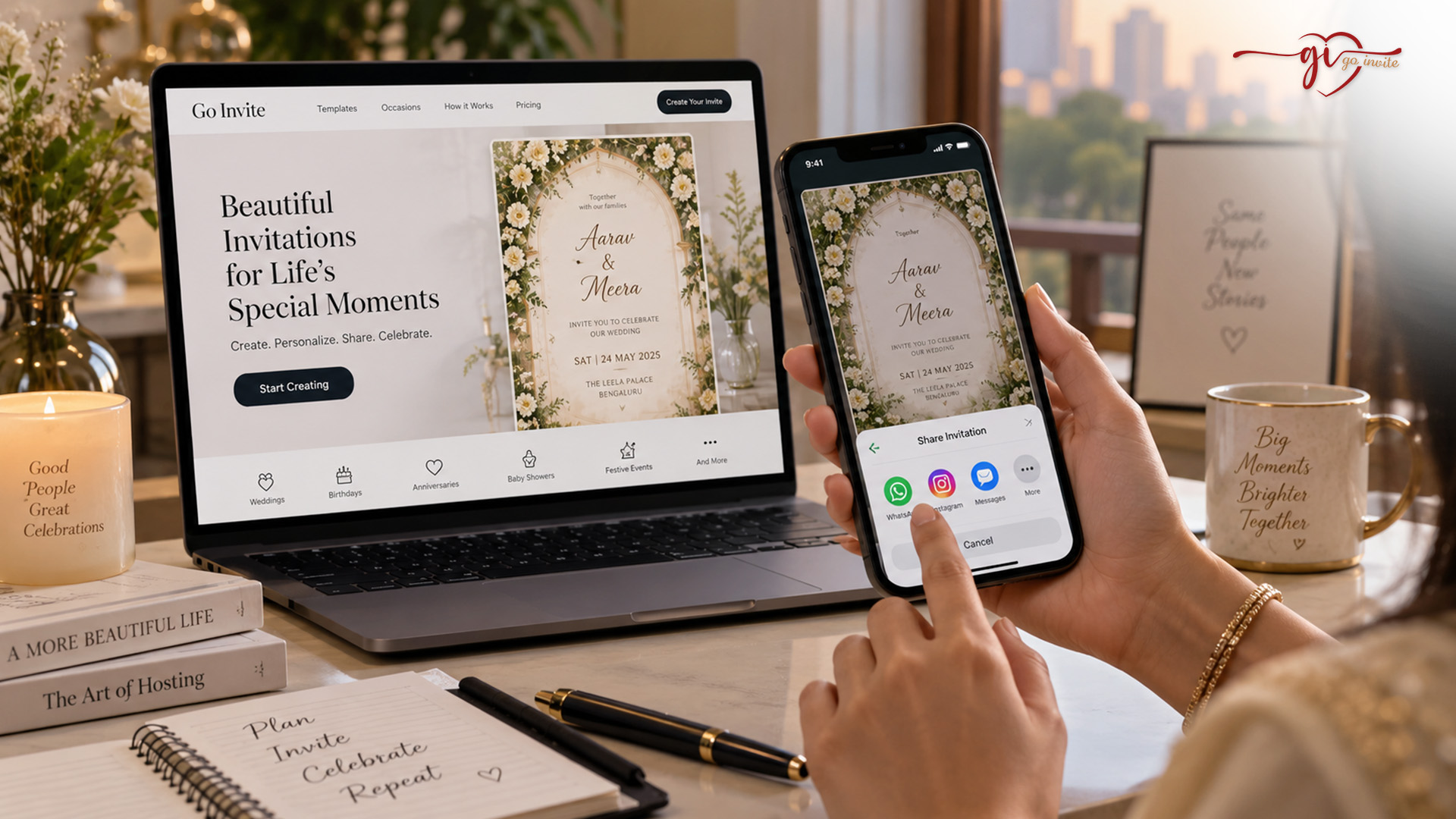
Invitations have always been an important part of bringing people together. Whether it is a wedding, birthday, housewarming, festival, baby shower or a family celebration, the invitation is often the first thing guests see. For years, printed cards were the usual way to invite people. Today, however, more people are choosing digital invitations instead.
Digital invitations have become a common part of how people plan and share celebrations. Instead of printing dozens or hundreds of cards and personally handing them out, hosts can create an invitation and share it directly with their guests through WhatsApp, email or social media.
This change is not simply about technology. It is also about how people communicate today. Most of us already use our phones to talk to family, friends, colleagues and other people we know. So, sending an invitation digitally can feel like a natural extension of the way we already stay connected.
Invitations Have Moved to Where People Communicate
One of the biggest reasons digital invitations are becoming popular is simple: people are already on their phones.
WhatsApp, in particular, has become an important part of everyday communication in India. Family groups, friends’ groups, housing society groups and work groups are all used to share information quickly. An invitation can easily become part of these conversations.
Instead of waiting for a printed card to reach someone, a digital invitation can be sent within seconds. Guests can open it, check the details and save the information on their phones.
This is especially useful when people live in different cities or countries. A wedding invitation, for example, can be shared with relatives in Mumbai, Delhi, Bengaluru, Dubai, London or New York without needing to send a physical card to each location.
Digital Invitations Are Easier to Share
A printed invitation usually has one physical copy that needs to reach the guest. A digital invitation does not have the same limitation.
Once the invitation is ready, it can be shared with multiple people. If someone asks for the invitation again, there is no need to find another physical copy. The host can simply forward the digital invitation.
This also makes it easier when plans involve several groups of people. One invitation can be shared with family members, friends, colleagues and other guests through different WhatsApp chats or platforms.
The convenience becomes even more noticeable when the guest list is large. Instead of managing a large number of printed cards, hosts can manage the invitation from their phone.
There Is More Room for Creativity
Printed invitations have their own charm, but they are limited by the physical format. A digital invitation can offer more ways to present an event.
A simple digital invitation can use colours, illustrations, photographs, animations or short videos. A wedding invitation can include the couple’s photographs. A birthday invitation can have a playful theme. A festival invitation can use traditional artwork and music.
Video invitations have also become popular because they can create a stronger sense of the event before it even begins. Instead of simply reading the date, time and location, guests can get a visual idea of what the celebration is going to feel like.
The important thing is that creativity does not always have to mean something complicated. Even a simple, well-designed invitation can look personal and meaningful when it matches the occasion.
Guests Can Keep the Details on Their Phones
Another practical advantage of digital invitations is that guests do not have to worry about keeping track of a physical card.
A printed invitation can be misplaced, especially when someone receives several invitations around the same time. With a digital invitation, the information remains in the chat or email where it was received.
Guests can also refer to the invitation later when they need to check the venue, date or timing.
For events with multiple functions, digital invitations can make this even easier. Guests can keep the details of the mehendi, sangeet, wedding, reception or other functions in one place rather than having to keep track of multiple pieces of paper.
Changes Are Easier to Communicate
Event planning does not always go exactly as expected. A venue might change. A timing might be adjusted. An additional function might be added.
With printed invitations, making changes can become difficult once the cards have already been printed and distributed.
Digital invitations make communication easier when details change. Hosts can send an updated invitation or message to guests without having to print another set of cards.
Of course, important changes should still be communicated clearly rather than assuming that everyone will notice an updated invitation. But having the option to update and resend information makes the process much more convenient.
Digital Invitations Can Feel More Personal
There is sometimes a misconception that digital invitations are less personal because they are sent through a phone.
That depends largely on how the invitation is created and shared.
A generic message forwarded to hundreds of people may not feel very personal. But a thoughtfully designed digital invitation, shared with a personal message, can still feel warm and meaningful.
For example, a family can send a digital wedding invitation along with a short message personally addressed to relatives and friends. The combination of the invitation and the message can make the experience feel much more personal than simply dropping a link into a group.
The technology is only the format. The thought behind the invitation is what makes it personal.
They Can Be More Practical for Large Guest Lists
Large celebrations often involve a lot of coordination. There may be hundreds of guests, multiple functions and people living in different locations.
Digital invitations can make one part of this process easier.
Instead of keeping track of printed cards, envelopes and physical delivery, hosts can focus on creating one invitation that can be shared across different channels.
This does not mean every event needs to completely replace printed invitations. Some families may still prefer physical cards for close relatives or important occasions. Digital invitations can simply provide another option that works better for certain groups of guests.
Digital Invitations Can Include More Information
A physical card has limited space. Once the design is printed, there is only so much information that can comfortably fit on it.
Digital invitations can make it easier to include additional event details.
For example, an invitation can include the venue address, Google Maps location, dress code, event schedule or contact information. A wedding invitation can even include separate details for different functions.
This is particularly useful for guests who are travelling from another city. Having all the information available digitally means they can refer to it whenever they need it.
They Can Reduce Paper Use
Another reason people are considering digital invitations is the amount of paper involved in traditional invitations.
Large events can require hundreds of printed cards. While one invitation may not seem like much, the total amount of paper used for a large guest list can add up.
Digital invitations reduce the need for printing and physical distribution. For people who want to make some parts of their celebrations less dependent on paper, this can be a simple change.
It does not make an event completely waste-free, of course. But choosing digital invitations can reduce one part of the traditional process.
Digital Invitations Are Especially Useful for Last-Minute Events
Sometimes an event comes together quickly. A family may decide to organise a small celebration, a festival gathering or a birthday party with limited preparation time.
Getting printed invitations designed, printed and distributed may not make sense in such situations.
A digital invitation can be created and shared much faster. Guests can receive the details almost immediately, making it useful for occasions where time is limited.
This is one reason digital invitations have become particularly common for smaller celebrations and informal gatherings.
The Traditional Invitation Is Not Disappearing Completely
The rise of digital invitations does not necessarily mean that printed invitations are going away.
Physical invitation cards still have emotional value for many people. A beautifully designed wedding card can become a keepsake. Families may also prefer giving printed invitations to elders or personally visiting close relatives with an invitation.
Digital and printed invitations can exist together.
Some families may choose a printed card for their closest relatives and a digital invitation for friends and guests who live farther away. Others may prefer digital invitations for the entire event.
The right choice depends on the occasion, guest list, family preferences and the kind of experience the host wants to create.
What Makes a Good Digital Invitation?
A good digital invitation does not need to be complicated.
The most important thing is that guests should be able to understand the event details easily. The name of the occasion, date, time and venue should be clear. If there are multiple functions, the information should be organised in a way that is easy to follow.
The design should also match the occasion. A wedding invitation may have a different visual style from a birthday party or Ganesh Chaturthi celebration.
Most importantly, the invitation should work well on a mobile screen because that is where most guests are likely to view it.
A beautiful invitation is useful only when guests can quickly understand what it is telling them.
The Way We Invite People Is Changing
The shift towards digital invitations reflects a larger change in the way people communicate.
We order food through our phones, book travel through apps, send photographs instantly and stay connected with people who may be thousands of kilometres away. It makes sense that invitations are moving in the same direction.
Digital invitations bring together convenience, creativity and easy sharing. They make it simpler to invite guests across different locations while giving hosts more freedom in how they present their celebrations.
Printed invitations will continue to have their place, especially for occasions where the physical card itself is part of the experience. But digital invitations have become more than just an alternative.
For many people, they are becoming the natural way to invite guests in a world where celebrations may be planned in one place and shared with people everywhere.
Conclusion
Digital invitations are becoming popular because they fit naturally into the way people communicate today. They are quick to share, easy to access, simple to update and flexible enough to suit different kinds of celebrations.
More importantly, they do not have to feel less personal than traditional invitations. With the right design and a thoughtful message, a digital invitation can still carry the excitement and warmth of the occasion.
As celebrations become more connected and guests increasingly rely on their phones for everyday communication, digital invitations are likely to become an even more familiar part of how people invite, inform and bring their guests together.