
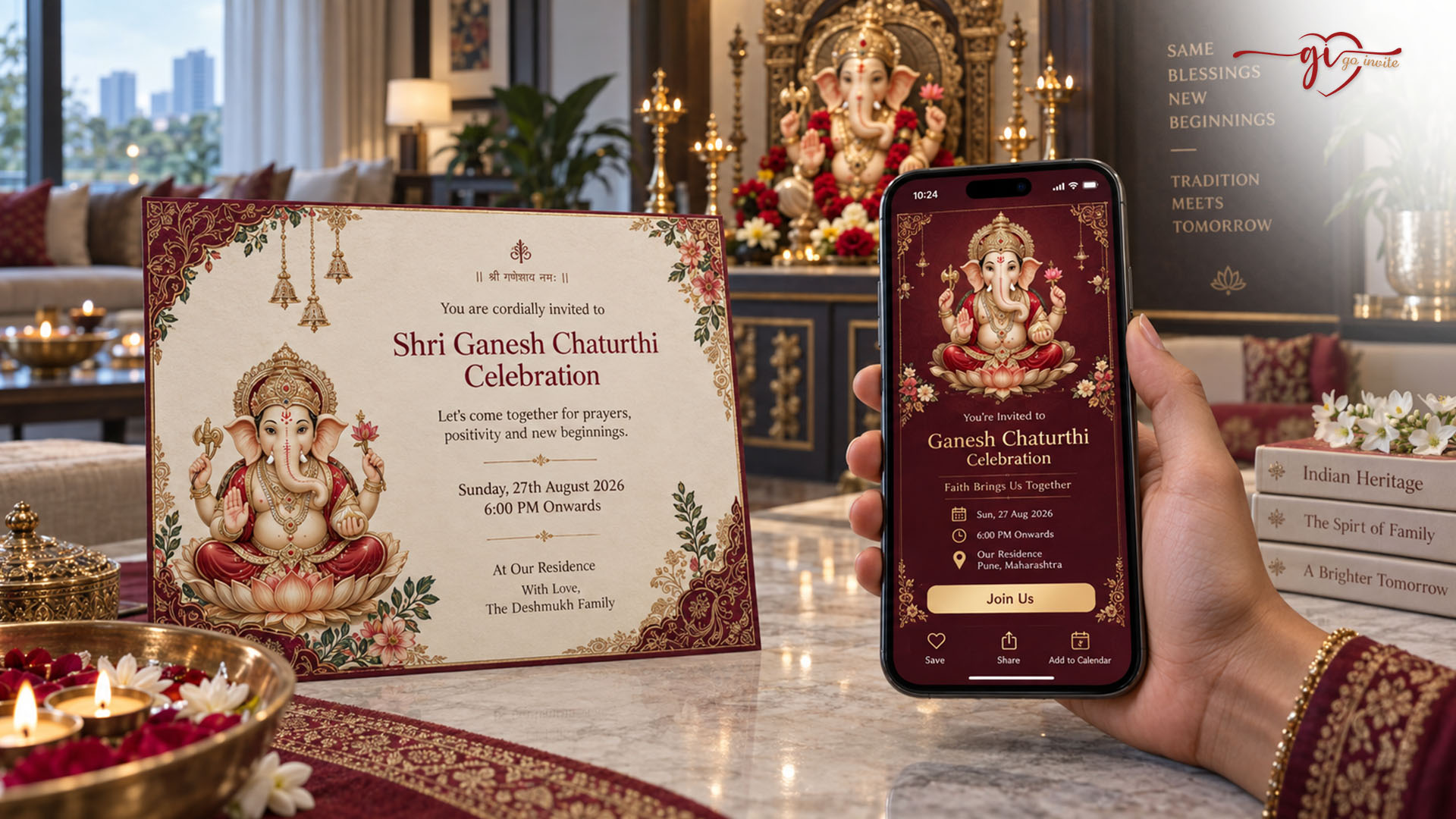
Ganesh Chaturthi has always been a festival where people come together. Families invite relatives, friends visit each other, housing societies organise celebrations, and communities come together for aarti, prasad and cultural events.
For years, the invitation was simple. Someone would print invitation cards, distribute them personally or send them through a family member. Later, WhatsApp messages became a common way to invite people. Today, another change is taking place.
In 2026, Ganesh Chaturthi invitations are becoming more digital.
This does not mean traditional invitation cards are disappearing. Many families still prefer printed cards because they feel personal and traditional. But digital invitations are becoming a convenient option for people who want to create, edit and share an invitation quickly.
From WhatsApp invitation images and videos to simple invitation websites, people now have several ways to invite guests to their Ganesh Chaturthi celebrations.
So, which is better: a traditional invitation or a digital one?
The answer depends on the occasion, the people you are inviting and how you want the invitation to reach them.
Traditional Ganesh Chaturthi Invitations Still Have Their Place
Printed invitations continue to be popular, especially for family celebrations and larger community events.
There is something special about receiving a physical invitation. A family may choose a traditional Ganesh Chaturthi card, write the names of their guests and personally hand it over to relatives, neighbours or close friends.
For many people, this is part of the celebration itself.
A printed invitation can also feel more personal when inviting elders, close family members or guests who may not regularly use digital platforms.
Housing societies and community groups may also continue using printed invitations for important announcements and celebrations, particularly when the event is planned for a large number of residents.
However, printed invitations also come with a few practical problems.
They need to be designed, printed and distributed. If there is a mistake in the date, time or address, making changes can become difficult. Printing more copies also means additional cost and effort.
This is where digital invitations have started becoming more useful.
Why Digital Ganesh Chaturthi Invitations Are Growing in 2026
The biggest reason behind the rise of digital invitations is simple: convenience.
Most people already use WhatsApp every day. Instead of printing hundreds of cards and distributing them, families and organisers can create a digital invitation and share it directly with their guests.
A digital invitation can be sent to a family group, individual contacts, society groups or friends within a few seconds.
There is also no need to wait for printing.
If the Ganesh Chaturthi celebration is coming up soon and you suddenly realise that you have forgotten to invite a few people, a digital invitation can solve the problem quickly.
This is particularly useful for last-minute invitations.
Digital invitations are also easier to update. If the venue changes or the timing of the aarti is different, the invitation can be edited before it is shared again.
That makes digital invitations practical for modern celebrations where plans can sometimes change.
WhatsApp Is Becoming the Main Invitation Channel
One of the biggest changes in 2026 is not necessarily the design of the invitation. It is the way people receive it.
WhatsApp has become one of the easiest ways to reach friends, relatives and neighbours.
A simple Ganesh Chaturthi invitation image can be created with the name of the family, event details, address, date and time. It can then be shared directly through WhatsApp.
For many people, this is enough.
There is no need for a complicated website or a long message. A well-designed invitation image containing all the important information can do the job.
This is why WhatsApp-friendly invitation designs are becoming increasingly popular.
The invitation should be easy to read on a mobile screen. The date, time, location and event details should be clearly visible instead of being hidden inside too much design.
The goal is simple: open the message, understand the invitation and know where and when to come.
Digital Invitations Are Not Just About Images
While invitation images are probably the most common format, digital invitations have expanded beyond a simple picture.
Some families and organisations are now using short invitation videos.
A video can include Lord Ganesha visuals, traditional music, family names, event details and a short message inviting guests to the celebration.
This gives the invitation a more personal feel without requiring a printed card.
Another option is a simple Ganesh Chaturthi invitation website.
Instead of sending all the information through multiple WhatsApp messages, a family or society can share one link containing the complete event details.
The website could include the invitation, date, timing, location, Google Maps directions, event schedule and other information.
This can be especially useful for larger celebrations where there are several activities planned across multiple days.
Traditional vs Digital: What Is Actually Better?
There is no single answer.
A traditional invitation works well when the occasion is more personal and you want the physical card to be part of the experience.
A digital invitation works well when speed, convenience and easy sharing are more important.
For example, a family may still print a small number of traditional cards for close relatives while using WhatsApp invitations for friends and other contacts.
This combination can give people the best of both options.
The printed card keeps the traditional feeling, while the digital invitation makes it easier to reach everyone else.
Digital Invitations Are More Practical for Housing Societies
Ganesh Chaturthi celebrations in housing societies can involve hundreds of residents.
Organisers may need to communicate the dates of the celebrations, aarti timings, cultural programmes, competitions, prasad distribution and other activities.
Printing a separate invitation for every resident may not always be practical.
A digital invitation can make communication much easier.
A society can create one invitation image and share it in the residents’ WhatsApp group. If the celebration includes several events, a digital invitation website can provide all the information in one place.
The same link can also be shared with new residents, guests and visitors without creating another invitation every time.
For organisers, this can save both time and effort.
Personalisation Is Becoming Easier
Another major advantage of digital invitations is personalisation.
A traditional printed invitation generally needs to be finalised before it goes to print. With digital invitations, changes can be made much more easily.
The host’s name, family name, society name, venue or event details can be added before the invitation is shared.
Some digital invitation services also allow people to choose from different designs and make basic changes themselves.
This makes the process simpler for people who do not have graphic design experience.
Instead of hiring a designer for a simple invitation, they can choose a ready-made design, enter their details and share the final invitation.
The Cost Factor Also Matters
Cost is another reason why digital invitations are becoming popular.
A printed invitation involves several expenses. There is the cost of designing, printing and sometimes delivering the cards.
Digital invitations remove most of these physical costs.
This does not mean every digital invitation has to be free. Some professionally designed invitations, videos and websites may still have a cost.
However, for someone looking for a simple Ganesh Chaturthi invitation, digital options can be more affordable and practical.
This becomes even more useful when the invitation needs to be shared with a large number of people.
Digital Does Not Have to Mean Complicated
One misconception about digital invitations is that they need to look highly designed or complicated.
They do not.
A good Ganesh Chaturthi invitation can be very simple.
It can have a traditional Ganesh image, the name of the family or society, a short invitation message, date, time and location.
The most important thing is readability.
Too many fonts, colours, animations or design elements can actually make an invitation harder to understand.
In 2026, the trend is moving towards invitations that look good but remain easy to read and share.
Will Printed Invitations Disappear?
Probably not.
Ganesh Chaturthi is deeply connected to tradition, family and community. Printed invitations are part of that tradition for many people.
Instead of completely replacing traditional invitations, digital invitations are giving people another option.
Someone can still hand a printed card to their grandparents while sending a WhatsApp invitation to a college friend.
A housing society can put up physical notices while sharing the same information digitally.
The two formats can easily exist together.
The Future of Ganesh Chaturthi Invitations
The future of Ganesh Chaturthi invitations is likely to be a combination of traditional and digital formats.
People will continue to value the emotional connection of a physical invitation, but they will also expect the convenience of digital communication.
This means invitations may become more flexible.
A simple invitation image may be enough for a small family gathering. A short video may work better for a larger celebration. A website may be useful for a multi-day society event.
The important thing is not whether an invitation is traditional or digital.
It is whether it makes the information easy to understand and helps people feel invited.
So, Traditional or Digital?
The answer depends on what you need.
If you want something personal and traditional, a printed Ganesh Chaturthi invitation can still be a great choice.
If you want something quick, affordable and easy to share, a digital invitation may make more sense.
And if you want both, there is nothing wrong with using both.
Ganesh Chaturthi is ultimately about bringing people together. The invitation is simply the first step.
In 2026, that step may arrive as a printed card at your doorstep, a WhatsApp message on your phone or even a simple invitation website.
The format may be changing, but the purpose remains the same: to invite people to celebrate together.